San Francisco sits across a mosaic of soil conditions that shift within a single block—from Colma Formation sands in the Richmond to soft Bay mud south of Market. Over 800,000 people live on this 7x7-mile peninsula, where the 1906 earthquake still informs every grading decision. An exploratory test pit gives you a direct look at the subsurface before committing to a foundation design. Unlike drilling alone, a test pit lets the geotechnical engineer examine stratification, moisture, and fill boundaries with their own eyes. For additions in Noe Valley or ADU construction in the Sunset, a well-placed test pit can reveal undocumented debris or perched groundwater that standard borings might miss. We combine field observation with grain-size analysis to fine-tune bearing capacity assumptions without waiting for lab results.
A single exploratory test pit in San Francisco can reveal undocumented fill, perched water, or bedrock depth—data that changes foundation cost by thousands.
Scope of work in San Francisco
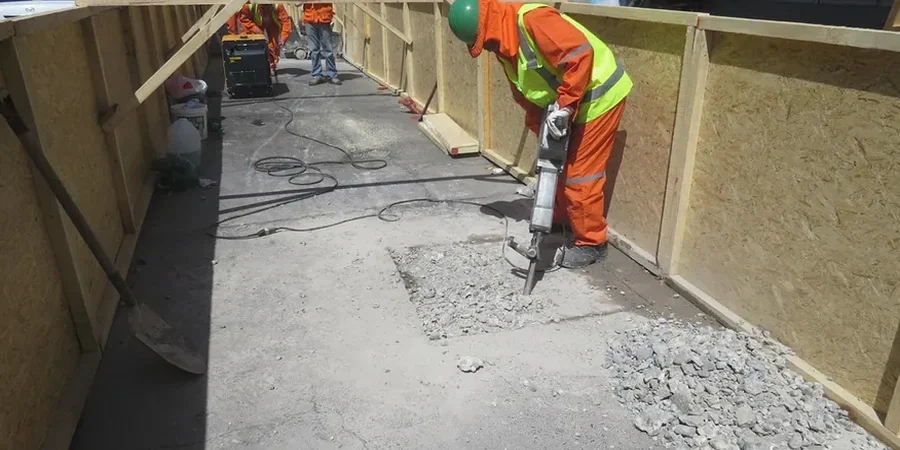
Critical ground factors in San Francisco
San Francisco's 2022 Building Code (IBC-based) enforces Chapter 18A requirements for soil investigations when structures exceed one story or slope exceeds 15%. Skipping a test pit on a site mapped as artificial fill—which covers roughly one-third of the city—can trigger costly foundation redesigns after the inspector flags undocumented soil. In the Marina and South of Market, post-1906 fill contains rubble, timber remnants, and loose sand lenses; a test pit that misses these can lead to differential settlement and cracked slabs within the first five years. The city's proximity to the San Andreas and Hayward faults makes accurate shear-wave velocity profiling essential, and direct pit observation helps calibrate whether deeper liquefaction analysis is warranted. A single overlooked debris pocket can shift a project from a standard mat foundation to an expensive deep-pile solution.
Our services
Our exploratory test pit work in San Francisco is backed by field crews familiar with the city's permit process, traffic control requirements, and the patchwork geology that makes each neighborhood distinct. Each pit is treated as a forensic window into the site.
Standard Exploratory Test Pit
Excavation to 14 feet with continuous soil logging per ASTM D2487. Includes hand penetrometer testing, moisture sampling, and digital photo documentation of strata.
Fill Delineation Pit
Targeted excavation to identify the boundary between artificial fill and native soil. Critical for Marina, SoMa, and Financial District sites where post-1906 debris is common.
Infiltration & Percolation Pit
Test pit extended to planned infiltration depth with in-situ permeability testing. Supports San Francisco Public Utilities Commission (SFPUC) stormwater compliance for green infrastructure.
Bedrock Verification Pit
Shallow excavation in hillside zones (Potrero, Twin Peaks, Diamond Heights) to confirm Franciscan bedrock depth and weathering grade for foundation bearing decisions.
Top questions
How much does an exploratory test pit cost in San Francisco?
A standard exploratory test pit in San Francisco typically ranges from US$540 to US$960, depending on depth, access constraints, and whether traffic control or pedestrian protection is required. Sites in dense neighborhoods like North Beach or Chinatown may trend toward the upper end due to tighter logistics and permit coordination.
Does a test pit replace a full geotechnical investigation?
A test pit is one component of a broader investigation. It provides direct visual and tactile soil data that complements drilling, CPT soundings, or geophysical surveys. For most San Francisco building permits, the Department of Building Inspection expects a combination of borings and test pits on sites with known fill history.
How deep can you excavate a test pit in San Francisco?
We routinely excavate to 12 to 14 feet with a standard excavator. Beyond 14 feet, or when groundwater is encountered above the pit bottom, the excavation must be evaluated for shoring or benching under Cal/OSHA requirements. In loose Bay mud, sloughing can limit practical depth even before groundwater appears.
What does the test pit log include?
The field log records soil type per USCS classification (ASTM D2487), color, moisture condition, consistency or density, depth to groundwater seepage, and any fill debris or organic material. Photographs of the pit face and excavated material are included. The final report correlates pit observations with any lab testing performed on grab samples.
How quickly can a test pit be scheduled in San Francisco?
In most San Francisco neighborhoods, we can mobilize within five to seven business days after site access is confirmed. The excavation is completed in one day, with the field log delivered immediately. The formal report follows within three to five business days. Sites requiring SFMTA encroachment permits or special traffic plans may add one to two weeks to the timeline.