San Francisco's rapid post-1906 rebuild placed entire neighborhoods on artificial fill over the old Yerba Buena Cove, creating a patchwork of dune sand, serpentinite rubble, and compressible Bay Mud that changes by the block. A routine test pit program in the Marina District can hit loose hydraulic fill at 3 feet, while a borehole two blocks west in Pacific Heights encounters dense Colma sand at the surface—same city, completely different grain size curves. We run the full sieve stack plus hydrometer on every sample because classifying a soil as “sandy silt” versus “silty sand” flips the seismic site class under ASCE 7 and changes the foundation design. For CPT soundings that stop on Franciscan bedrock floaters, we use the grain size data to cross-calibrate soil behavior type and keep the investigation moving.
Bay Mud fines content from a single sample can shift the liquefaction susceptibility assessment from “moderate” to “high” under a M7.0 scenario on the San Andreas.
Scope of work in San Francisco
Critical ground factors in San Francisco
San Francisco sits at 52 feet above sea level on average, but what matters for grading is that roughly one-third of the city is built on artificial fill mapped as liquefaction hazard zone by the California Geological Survey. Skipping the hydrometer on a silty sand from Treasure Island or the Embarcadero means you miss the 15-to-35-percent fines window where cyclic resistance can either improve or degrade depending on plasticity. A grading curve that stops at the No. 200 sieve tells you nothing about the clay fraction, and that gap has led to retaining wall backfill failures in the Financial District when contractors assumed free-draining material that actually held pore pressure. The hydrometer step adds a day to the lab schedule but it is the cheapest insurance against a mistaken USCS classification that cascades into a flawed liquefaction trigger analysis.
Our services
Our San Francisco lab runs the complete mechanical and sedimentation sequence under one roof so the project engineer gets a single, coherent particle size curve without having to merge reports from separate facilities.
Full ASTM D6913/D7928 Package
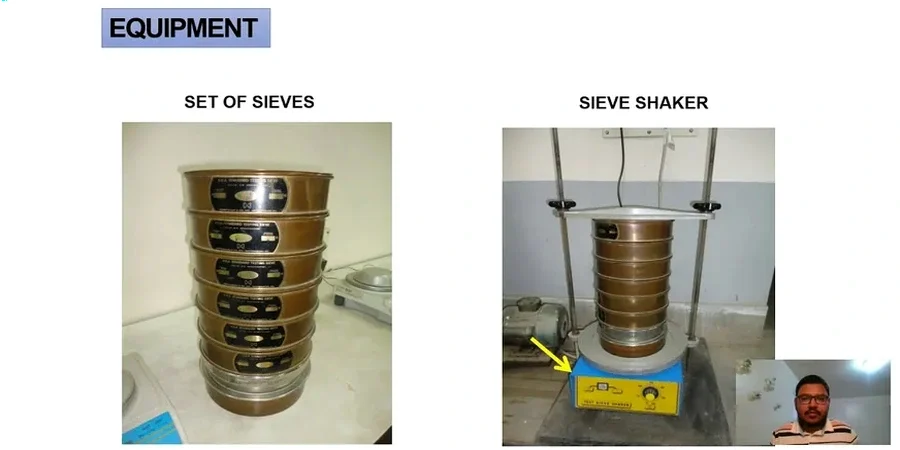
Washed sieve analysis on the coarse fraction plus hydrometer sedimentation on the minus No. 200 material. Includes oven-dry moisture content, gradation table, semi-log plot, USCS classification per ASTM D2487, and computed Cu/Cc coefficients for filter and drainage design.
Liquefaction Screening Suite
Grain size curve overlaid with Tsuchida (1970) and Boulanger & Idriss (2014) fines-content boundaries for liquefaction susceptibility. Delivered alongside Atterberg limits when the sample plots in the transitional silt-clay range that requires plasticity context.
Top questions
How much does a grain size analysis with hydrometer cost for a San Francisco project?
A complete sieve-plus-hydrometer package following ASTM D6913/D7928 typically runs between US$90 and US$180 per sample, depending on whether we are testing a clean sand that needs minimal hydrometer effort or a high-plasticity Bay Mud that requires extended sedimentation readings and a companion Atterberg limits run. Volume pricing applies for five or more samples from the same investigation.
Can you run the hydrometer analysis on samples that have already been air-dried in the field?
We can, but we strongly prefer to receive the sample in its field-moist condition inside a sealed jar or bag. Air-drying a fat clay from the Bay Mud can create irreversible aggregates that do not fully disperse during the sodium hexametaphosphate soak, shifting the hydrometer curve toward a coarser apparent grain size and undercounting the true clay fraction.
What is the smallest sample mass you need for a reliable hydrometer test?
For silt-clay mixtures we ask for at least 200 grams of material passing the No. 10 sieve. If the sample is predominantly sand with a small fines fraction, the full 500-gram split is better because we need enough minus-No. 200 material to run the hydrometer without re-using the same suspension. Our lab will always notify the driller if the recovered mass is marginal before starting the analysis.