San Francisco’s dramatic growth from 1849 gold rush settlement to dense urban center left a legacy of layered fill over bay mud and dune sand. Much of the Financial District and South of Market sits on artificial ground that compresses unevenly under load. Raft and mat foundation design offers a practical solution for these conditions, distributing structural weight across a continuous slab to reduce differential settlement. The approach works well for mid-rise buildings on the city’s variable profiles, where isolated footings would tilt or crack. A proper raft design in San Francisco must account for the underlying compressible clay lenses mapped by USGS, and for the seismic demands of a region that experienced the 1906 and 1989 Loma Prieta events. Before finalizing a mat geometry, we often correlate subsurface data with a CPT test to refine the soil stiffness profile across the site.
A properly designed raft foundation turns San Francisco's variable fill and bay mud into a manageable bearing platform, cutting differential settlement by half compared to isolated footings.
Scope of work in San Francisco
Critical ground factors in San Francisco
San Francisco sits at 52 feet above sea level on average, but the elevation changes sharply from sea level at the Embarcadero to 925 feet at Mount Davidson, compressing multiple microclimates and soil regimes into 47 square miles. This compressed geography means a raft foundation designed for the dense sands of the Richmond District will not work in the artificially filled zones of Mission Bay. The biggest risk is underestimating long-term consolidation settlement in the soft clays underlying the artificial fill: a mat that looks adequate under short-term loading can gradually dish over a decade, cracking partition walls and jamming doors. The 2016 USGS HayWired scenario reminded engineers that a major Hayward Fault rupture would impose both strong shaking and permanent ground displacement. A raft design that ignores these dual demands leaves the structure vulnerable to costly post-earthquake repairs. Our analysis explicitly models the consolidation timeline and the seismic soil-structure interaction, giving owners a foundation that performs from day one through the next major event.
Our services
Our San Francisco raft and mat foundation design service covers every phase from initial feasibility to construction support. We focus on practical, buildable solutions that Bay Area contractors can execute efficiently.
Mat Foundation Analysis and Detailing
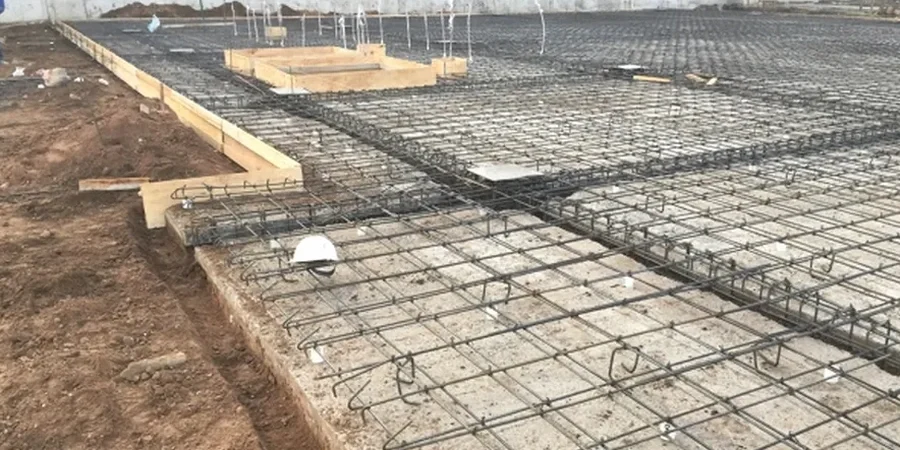
Full 3D finite element modeling of the raft slab with soil springs calibrated to San Francisco subsurface data. We deliver reinforcement drawings, camber specifications, and a sequenced construction plan that accounts for the Bay Area's tight urban site constraints.
Geotechnical Investigation for Raft Design
Targeted subsurface exploration program including mud rotary borings, CPT soundings, and laboratory consolidation tests on bay mud samples. The resulting geotechnical report provides the design parameters and seismic site class required for a code-compliant raft foundation.
Top questions
How much does raft/mat foundation design cost for a San Francisco project?
For a typical San Francisco mid-rise project, the engineering design and analysis for a mat foundation ranges from US$1,020 to US$3,980, depending on the building footprint, number of stories, and complexity of the subsurface profile. Sites with high liquefaction potential or deep bay mud require more extensive modeling, which falls toward the upper end of the range.
When is a mat foundation better than isolated footings in San Francisco?
A mat foundation becomes the better choice when the soil bearing capacity is low — common in the artificial fill and bay mud zones of San Francisco — or when the structural loads are high enough that isolated footings would overlap. It is also preferred when the tolerable differential settlement is tight, or when the basement must act as a water barrier against a high groundwater table, as in the low-lying areas near the Bay.
How do you account for San Francisco's seismic risk in raft foundation design?
Our design follows ASCE 7-22 seismic provisions, using the site-specific ground motion parameters from the USGS seismic hazard maps. We model the mat as a rigid diaphragm and analyze the soil-structure interaction under the design earthquake. For sites in Seismic Design Category D or E — which cover most of San Francisco — we also check liquefaction-induced settlement and bearing capacity loss in the post-liquefied condition, stiffening the raft or adding ground improvement if the predicted deformation exceeds ACI 318 serviceability limits. More info.