The geotechnical contrast between tunneling beneath the bedrock of Telegraph Hill and boring through the compressible Bay Mud under the Financial District defines engineering in San Francisco. The city sits on a complex geological mosaic where saturated Holocene deposits reach depths exceeding 100 feet in the former marshlands. Soft ground tunneling in San Francisco requires more than just a standard subsurface investigation; it demands an integrated understanding of pore pressure response during excavation, face stability in low-strength clays, and the three-dimensional arching that develops around a shallow urban tunnel. Our team approaches each San Francisco project with the same analytical rigor that has been essential since the construction of the BART transbay tube in the 1960s, combining field-derived parameters from CPT testing with advanced constitutive models to predict ground loss before the TBM ever launches.
In San Francisco, a one-foot change in tunnel alignment can mean the difference between stiff Colma Formation and fluid Young Bay Mud. That difference dictates everything—from TBM face pressure to settlement mitigation.
Scope of work in San Francisco
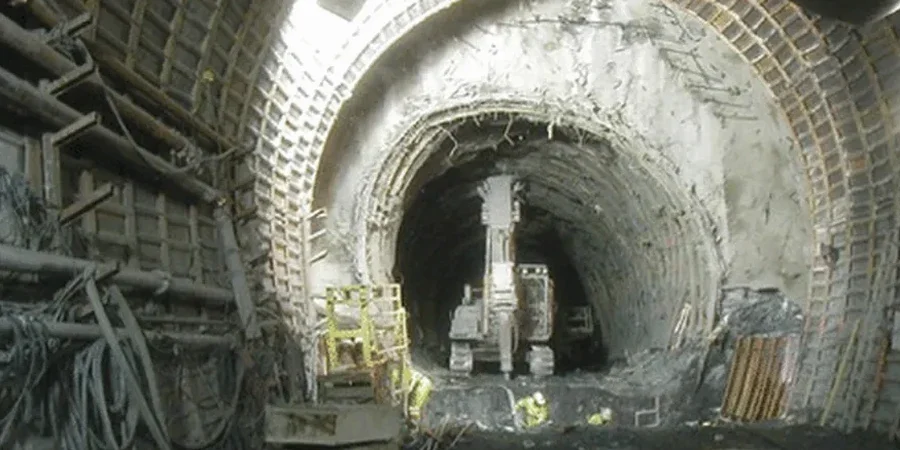
Field demonstration
Critical ground factors in San Francisco
The urban development of San Francisco following the 1906 earthquake aggressively filled the original shoreline, extending the city over the soft Yerba Buena Cove and Mission Bay. What was once a practical solution to land scarcity created a legacy of compressible, liquefiable ground that now challenges every major infrastructure project. The Central Subway project, completed in 2022, demonstrated that tunneling through San Francisco’s mixed-face conditions—where the tunnel crown encounters soft clay while the invert sits in dense sand—generates differential settlement patterns that can propagate to the surface in ways that elastic half-space models fail to capture. Our geotechnical analysis for soft ground tunnels explicitly models the construction sequence: staged excavation, annular gap geometry, and time-dependent consolidation around the lining. Without this level of detail, the risk of damaging historic structures like the Ferry Building or destabilizing existing BART tunnels becomes unacceptably high.
Our services
Our geotechnical analysis for soft ground tunnels in San Francisco is built around three core service components, each calibrated to the specific demands of Bay Area geology and regulatory oversight.
Advanced Laboratory Testing Program
We design testing suites that go beyond index properties, including CRS consolidation, K0-consolidated undrained triaxial with pore pressure measurement, and bender element tests to establish the stiffness degradation curve from very small to large strains.
Numerical Modeling of Excavation Sequences
Using finite element and finite difference codes, we simulate the complete tunneling process: face advance, segmental lining installation, tail void grout pressure dissipation, and long-term consolidation settlement to protect adjacent infrastructure.
Ground Movement and Damage Assessment
We apply the modified Gaussian settlement trough method integrated with building damage classification per Burland to evaluate the impact of volume loss on sensitive structures within the zone of influence.
Top questions
How do you determine the appropriate face pressure for an EPB TBM in San Francisco Bay Mud?
Face pressure is calculated using limit equilibrium methods that account for the undrained shear strength profile, overburden stress, and groundwater pressure at tunnel axis level. We typically target a support pressure ratio between 0.8 and 1.2 times the in-situ horizontal effective stress, adjusted in real time based on the CPTu-derived strength trends along the alignment.
What is the typical cost range for a comprehensive geotechnical analysis for a soft ground tunnel in San Francisco?
A comprehensive analysis typically ranges from US$4,720 for a preliminary desktop study to US$17,550 for a full design-phase package including laboratory testing, constitutive model calibration, and 2D/3D numerical simulation, depending on the linear footage and complexity of the subsurface conditions.
How do you handle the transition zones between soft clay and Franciscan Complex bedrock along a tunnel alignment?
Transition zones are addressed through targeted additional borings at closer spacing, geophysical cross-hole tomography to map the rockhead profile, and staged numerical models that simulate the abrupt change in face conditions. We specify transition rings and probe drilling protocols to manage the risk of face instability at the clay-rock interface.
What role does consolidation settlement play in the long-term performance of a soft ground tunnel?
Consolidation settlement around a tunnel in San Francisco’s soft clays can continue for years after construction due to the low permeability of Bay Mud. We model this using coupled flow-deformation analysis with Biot consolidation theory, and recommend lining designs that accommodate differential settlement at connections to stations and shafts. More info.