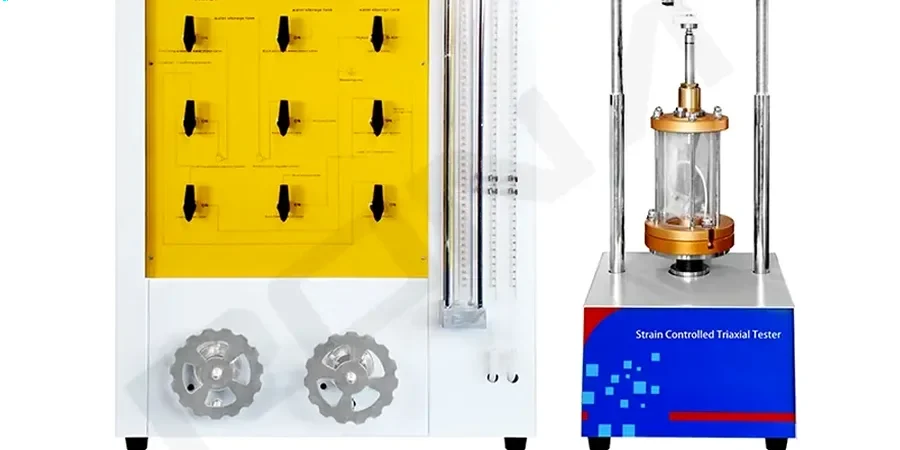
San Francisco’s rapid post-1906 reconstruction reshaped its urban grid atop dune sands, bay mud, and Franciscan Complex bedrock. Each formation reacts differently under shear, and the triaxial test is how we separate stable ground from layers that fail when pore pressure spikes. Whether a project sits on artificial fill near Mission Bay or weathered serpentinite in Presidio Heights, triaxial testing delivers the drained and undrained strength parameters that ASCE 7 and the California Building Code demand for seismic design. In a city where the next major earthquake is a certainty, not a possibility, the laboratory’s role becomes as critical as the structural engineer’s calculations. For deeper profiling before sampling, many teams pair this with spt drilling to recover representative specimens from the exact strata that control foundation performance.
Triaxial testing doesn’t just measure strength — it reveals how a soil’s skeleton behaves when the water inside it can’t escape fast enough during an earthquake.
Scope of work in San Francisco
Critical ground factors in San Francisco
A recurring mistake on San Francisco infill sites is running only index tests and assuming undrained shear strength from blow counts. When a contractor excavates adjacent to an existing foundation on Treasure Island or South of Market, the short‑term stability depends entirely on total stress parameters that SPT correlations cannot reliably predict for young bay mud. Without a proper triaxial campaign, the temporary shoring gets under‑designed, deformations accumulate, and adjacent structures settle beyond tolerance. The cost of a triaxial test is negligible next to the delay and liability of a shoring failure during the rainy season, when perched water raises pore pressures in the fill. In liquefaction‑triggering evaluations required by the San Francisco Building Code, missing the cyclic resistance ratio by even 15 percent — easily done with proxy correlations — can flip a site from ‘marginally acceptable’ to ‘mitigation mandatory,’ triggering stone column or deep soil mixing costs that could have been optimized with accurate lab data.
Our services
San Francisco projects that involve deep excavations, tall retaining structures, or performance‑based seismic design require more than a standard classification suite. These three service tiers cover the full workflow from specimen selection to numerical model input.
Consolidated‑Undrained (CU) with Pore Pressure
The workhorse for effective stress analysis. Three specimens consolidated to different isotropic pressures, sheared undrained, yielding c' and φ' for long‑term slope stability and foundation bearing capacity in saturated San Francisco clays and silts.
Cyclic Triaxial for Liquefaction
Specimens consolidated to in‑situ stress, then subjected to cyclic axial loading at 1 Hz. Determines the number of cycles to liquefaction at varying CSR levels, providing the site‑specific resistance curve that replaces generic SPT‑based charts.
Consolidated‑Drained (CD) with Volume Measurement
Slow‑shear tests on granular soils where pore pressure is kept near zero. Delivers the critical state friction angle and dilatancy parameters needed for advanced constitutive models in deep excavation and tunnel design beneath San Francisco’s urban core.
Top questions
How long does a triaxial testing program take for a San Francisco project?
A standard set of three CU specimens with pore pressure measurement typically requires 10 to 14 business days from specimen extrusion to final report. Saturation of low‑permeability bay mud samples can extend the timeline by several days. Cyclic triaxial programs add another week due to the number of loading stages. We coordinate sampling dates with the drilling crew so the lab receives specimens within 48 hours, minimizing moisture loss and disturbance.
What sample quality is acceptable for triaxial testing?
We require undisturbed Shelby tube samples with a minimum diameter of 3 inches, preferably 4 inches, sealed with wax immediately upon extraction. Samples showing visible disturbance, desiccation cracks, or gravel inclusions larger than 1/6 the specimen diameter are rejected per ASTM D4767 criteria. For San Francisco’s dune sands, which are difficult to sample undisturbed, we often recommend frozen sampling or in‑situ freezing techniques to preserve fabric before triaxial preparation.
What does triaxial testing cost for a typical San Francisco foundation investigation?
A complete triaxial suite — three CU specimens with pore pressure measurement, stress path plotting, and a signed geotechnical report — runs between US$1,860 and US$2,650 depending on the number of confining stages and the complexity of the soil type. Cyclic liquefaction testing is priced separately per specimen. For multi‑borehole projects, volume pricing applies once more than six triaxial specimens are submitted.
Do you perform triaxial testing on rock cores from San Francisco’s Franciscan Complex?
Yes, but with a different protocol. Intact rock triaxial testing follows ASTM D7012 for compressive strength and elastic modulus under confining pressure. Franciscan greywacke, serpentinite, and chert each require specimen preparation with diamond grinding to maintain end‑flatness tolerances of 0.001 inch. We typically run at least three confining pressures to define a Hoek‑Brown failure envelope, which is then used for tunnel and deep shaft design in the bedrock underlying San Francisco’s hills. More info.