San Francisco sits on some of the most complex geology in the country. The Bay Mud layer, which can reach over 90 feet deep in the Marina and parts of SoMa, compresses under load and amplifies shaking during a quake. We see too many preliminary designs that treat the city as uniform ground—it never is. Our pile foundation design work starts by mapping the transition zones between dune sand in the Sunset, serpentinite in the Presidio, and the artificial fill that lines the Embarcadero. Getting the pile type and toe elevation right here isn't just about bearing capacity; it's about surviving the next big one. When borehole data shows deep soft clay, we often integrate findings from our CPT testing to refine the skin friction profile, and for sites near liquefiable fills a liquefaction assessment becomes a non-negotiable step in the design loop.
In San Francisco, a pile's lateral performance under seismic drift often governs the design more than its vertical capacity.
Scope of work in San Francisco
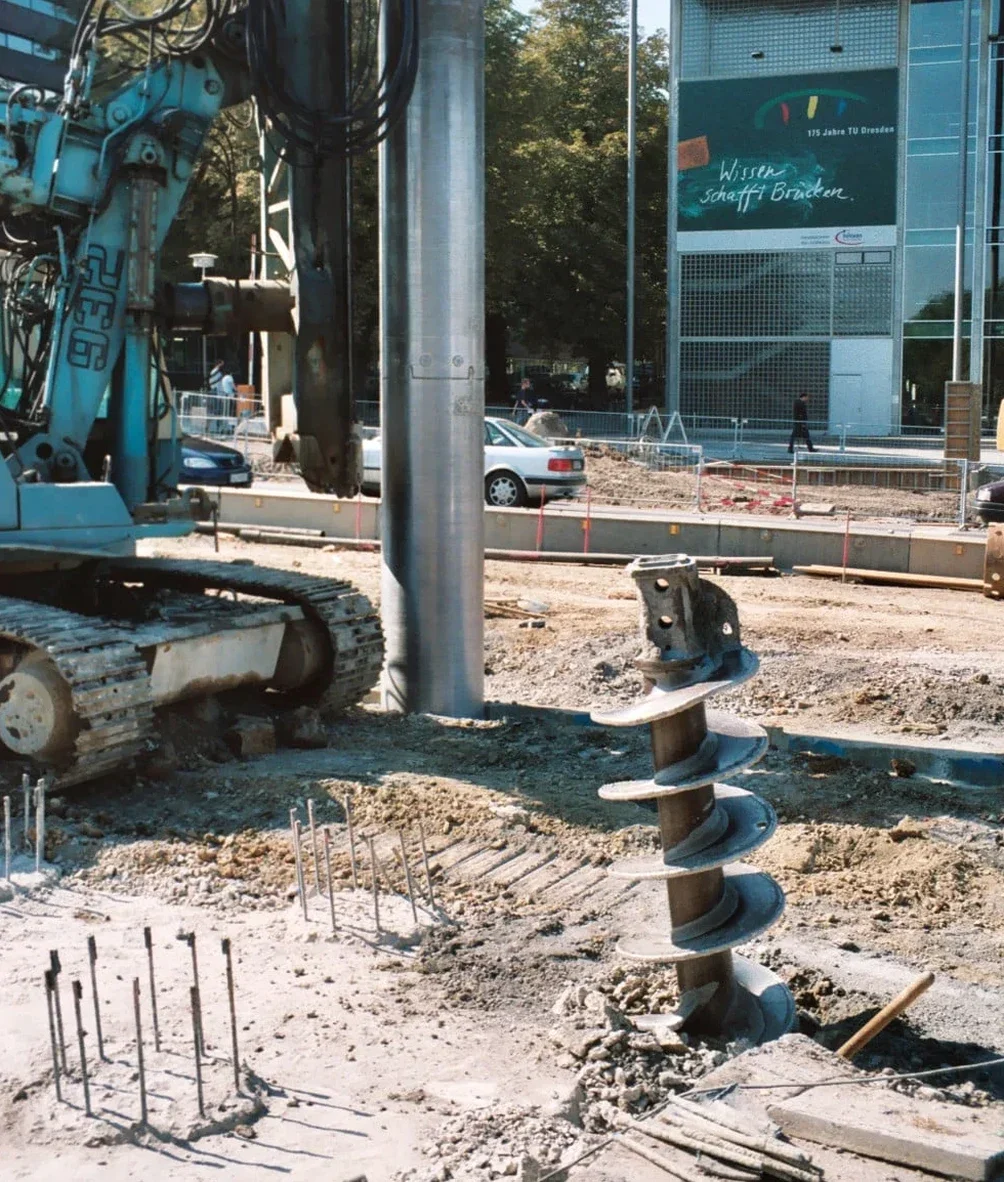
Critical ground factors in San Francisco
The IBC and San Francisco Building Code amendments demand explicit consideration of kinematic soil-pile interaction in Seismic Design Category E, which covers most of the city. Ignoring the downdrag caused by Bay Mud consolidation or the loss of lateral support in a liquefaction scenario can turn a code-compliant pile on paper into a structural failure in the field. A design that only checks axial capacity in drained conditions misses the critical undrained failure modes that Seed and Idriss documented in the Marina District after Loma Prieta. We routinely run sensitivity analyses on our pile foundation design, varying the groundwater table and the thickness of the liquefiable layer to bracket the worst-case performance. For sites near the bay's edge, the risk of corrosion-driven section loss in steel piles also demands a protective strategy that goes beyond standard paint systems.
Our services
We deliver a full engineering package around pile foundation design, from geotechnical characterization through construction oversight. Our scope adapts to the unique demands of San Francisco's hillside lots, infill parcels, and waterfront sites.
Deep Foundation Analysis
Axial and lateral capacity calculations for single piles and pile groups, including settlement and negative skin friction assessments in Bay Mud deposits.
Pile Load Testing Program
Design and specification of static compression, tension, and lateral load tests following ASTM D1143 and D3966, plus dynamic monitoring with PDA and CAPWAP analysis.
Seismic Pile Design
Performance-based design incorporating kinematic interaction, liquefaction-induced downdrag, and lateral spreading demands per ASCE 7 and PEER guidelines.
Value Engineering Reviews
Alternative pile type evaluations—comparing driven H-piles, CIDH shafts, and micropiles—to optimize cost and schedule while meeting San Francisco's permit requirements.
Top questions
What pile types work best in San Francisco's Bay Mud?
It depends on the load and the depth to competent bearing material. For high-rise structures in the Financial District, drilled CIDH piles socketed into the Franciscan Complex are common. For mid-rise projects in the Mission where the Colma Formation is shallower, driven H-piles or precast concrete piles can be more economical. We evaluate the specific stratigraphy at your site to recommend the most efficient system that meets the San Francisco Building Code.
How much does pile foundation design cost for a San Francisco project?
The engineering design fee typically ranges from US$1,610 to US$6,970, depending on the project's complexity, the number of pile types analyzed, and whether a load testing program must be designed. A simple single-family residential pile design falls at the lower end, while a multi-story mixed-use building requiring seismic analysis and construction-phase support is at the higher end.
Do I need a pile foundation instead of a shallow footing in San Francisco?
You'll likely need piles if your geotechnical report identifies Bay Mud, loose artificial fill, or a high liquefaction potential within the zone of influence. Much of the downtown, SoMa, and Marina areas require deep foundations. Even on the hillsides, a slope stability analysis might push the design toward piles if shallow footings would surcharge a steep slope.
What seismic criteria does San Francisco require for pile design?
San Francisco enforces Seismic Design Category E for most sites, which triggers specific requirements in ASCE 7-22 and the IBC. Our designs account for the amplified spectral accelerations on the soft soil profile, the kinematic forces from the surrounding ground during shaking, and the potential loss of lateral support if liquefaction occurs. We also check the structural capacity of the pile under the combined axial and flexural demands.