A persistent mistake in San Francisco engineering is treating base isolation as a simple product specification rather than a performance-based design process that must reconcile three-dimensional seismicity with site-specific geotechnical data. The city sits at the boundary of the Pacific and North American plates, where the San Andreas and Hayward faults generate ground motions with distinct frequency signatures that vary dramatically between the bedrock of Nob Hill and the soft bay mud of the Financial District. CPT testing provides the continuous soil profiling essential for defining isolator displacement demands at sites where the critical shear wave velocity contrast occurs within the upper 40 feet, while seismic refraction surveys help map the depth to Franciscan Complex bedrock—a parameter that directly governs the spectral shape used in bearing selection. Without integrating these subsurface investigations into the design basis, isolation systems risk being tuned to the wrong predominant period, which can amplify rather than attenuate structural response during a Hayward Fault rupture.
A properly tuned base isolation system shifts the fundamental period of a San Francisco mid-rise from the 0.3–0.6 second range—where Hayward Fault pulses concentrate energy—to 2.5 seconds or higher, reducing spectral accelerations by 60–80 percent.
Scope of work in San Francisco
Critical ground factors in San Francisco
ASCE 7-22 Section 17 establishes a risk-targeted framework that is particularly demanding for San Francisco sites because the deterministic MCE_R spectra in the downtown area—shaped by the Hayward Fault at a distance of approximately 12 kilometers—often exceed the probabilistic spectra that govern design in most other U.S. cities. The consequence is that isolator prototypes must be tested to displacement demands that push the limits of commercially available bearing diameters, a constraint that requires early coordination between the geotechnical engineer, the structural designer, and the bearing manufacturer. The IBC further mandates that the isolation system be designed for the simultaneous application of maximum considered earthquake shaking in two orthogonal horizontal directions plus 100 percent of the vertical seismic load effect, a combination that can produce net uplift in lightweight structures founded on soft bay mud if the overturning moment is not carefully managed through plan aspect ratio limits. Neglecting vertical-horizontal coupling in the bearing constitutive model—a shortcut sometimes taken during preliminary design phases—can underestimate the axial force variation by 40 percent or more, potentially exceeding the cavitation or buckling limits of elastomeric bearings.
Our services
Our San Francisco base isolation engineering scope covers the full design lifecycle, from feasibility studies that compare isolated and fixed-base alternatives through peer review and construction support. We work primarily with institutional and healthcare clients where post-earthquake functionality is a non-negotiable performance objective.
Nonlinear Time-History Analysis & Isolator Selection
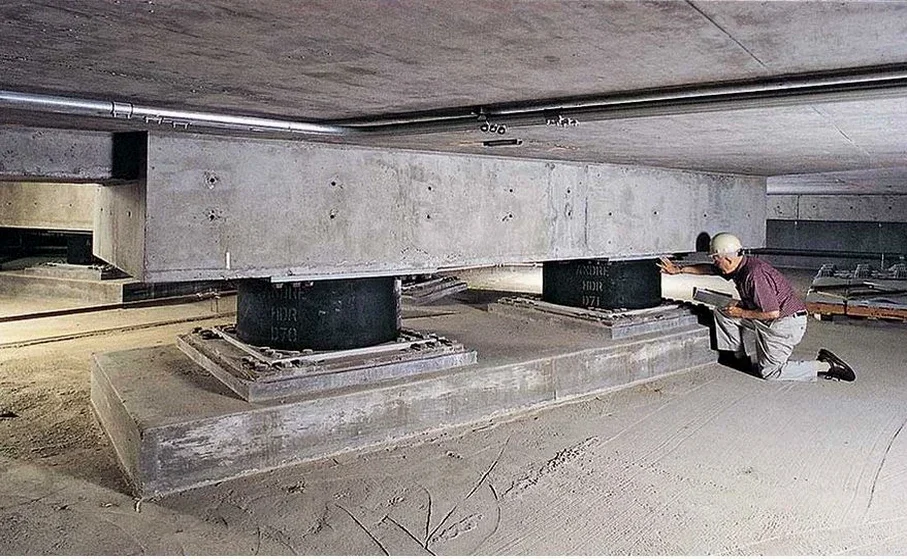
We develop three-dimensional structural models in ETABS or SAP2000 with explicit nonlinear link elements representing the isolation plane. Ground motion suites are selected from the PEER NGA-West2 database with spectral matching to San Francisco-specific conditional mean spectra, incorporating both San Andreas and Hayward Fault rupture scenarios. The analysis package includes upper bound and lower bound sensitivity studies, moat wall impact assessment, and bearing stability verification under maximum factored axial loads.
Geotechnical Integration & Isolation Pit Design
Base isolation effectiveness depends on the rigidity of the foundation diaphragm below the isolation plane. We specify and interpret MASW surveys and downhole seismic testing to constrain the small-strain shear modulus profile, then design the mat foundation or pile cap to limit differential settlement that could distort isolator end plates. For sites within San Francisco’s liquefaction hazard zones, we collaborate on ground improvement design—typically stone columns or deep soil mixing—to ensure the isolation plane remains level during and after strong shaking.
Top questions
What is the typical cost range for base isolation design services on a San Francisco mid-rise building?
For a typical San Francisco mid-rise structure in the 6- to 12-story range, our base isolation design services—including nonlinear time-history analysis, isolator specification, peer review coordination, and construction-phase support—generally range from US$3,980 to US$9,360 depending on the complexity of the ground motion selection, the number of prototype testing iterations required, and the extent of geotechnical integration needed for the isolation pit foundation.
How does the Hayward Fault influence isolation system parameters compared to the San Andreas Fault?
The Hayward Fault generates higher short-period spectral accelerations at downtown San Francisco sites because of its proximity (approximately 12 km) and its characteristic rupture directivity patterns. This typically forces the isolator effective period target to be longer—often 2.8 to 3.2 seconds—than would be required for a San Andreas event 20 km to the west, where the spectral shape is richer in longer periods. Our design process runs separate ground motion suites for each controlling fault and envelopes the displacement demands.
What peer review requirements apply to base-isolated buildings in San Francisco?
The California Building Code (CBC) requires independent peer review for all base-isolated structures, conducted by a California-registered Structural Engineer with demonstrated experience in seismic isolation. The peer reviewer evaluates the ground motion selection, the mathematical modeling assumptions, the prototype test results, and the quality assurance plan. In San Francisco, the Department of Building Inspection often imposes additional review requirements for essential facilities with Risk Category IV classification.
Can existing San Francisco buildings be retrofitted with base isolation?
Yes, and several historic buildings in San Francisco’s Civic Center and downtown have been retrofitted with base isolation as part of seismic upgrade programs. The process involves temporarily supporting the superstructure on jacking columns, cutting the existing columns at the isolation plane, and installing bearings in sequence. The primary geotechnical challenge is constructing the isolation moat without undermining adjacent footings, which typically requires secant pile walls or jet grouting. The cost premium over a conventional fixed-base retrofit is substantial, but for buildings with irreplaceable architectural fabric or essential post-earthquake functions, it is often the only solution that meets ASCE 41 Immediate Occupancy criteria.