San Francisco sits on a complex patchwork of Franciscan mélange, Colma formation sands, and deep compressible Bay mud that compacts unevenly under loading. Any engineered fill placed within the 46.9 square miles of this seismically active peninsula must achieve 90 to 95 percent relative compaction to resist differential settlement during a Hayward Fault event. We perform field density testing per ASTM D1556 using the sand cone method on trench backfill, subgrade preparation, and structural fill behind retaining walls. Over fill sequences exceeding 12 inches of lift thickness, we verify moisture-density relationships against the laboratory Proctor curve before the project moves forward. For deep excavations near Market Street where groundwater appears at 10 to 15 feet, we often schedule the sand cone test alongside an in-situ permeability test to correlate density with drainage behavior. The sand cone remains one of the few nuclear-free methods accepted by San Francisco Department of Building Inspection for compaction verification in sensitive urban corridors.
A 2 percent drop in field density below Proctor optimum can reduce bearing capacity by 30 percent on saturated San Francisco Bay fill.
Scope of work in San Francisco
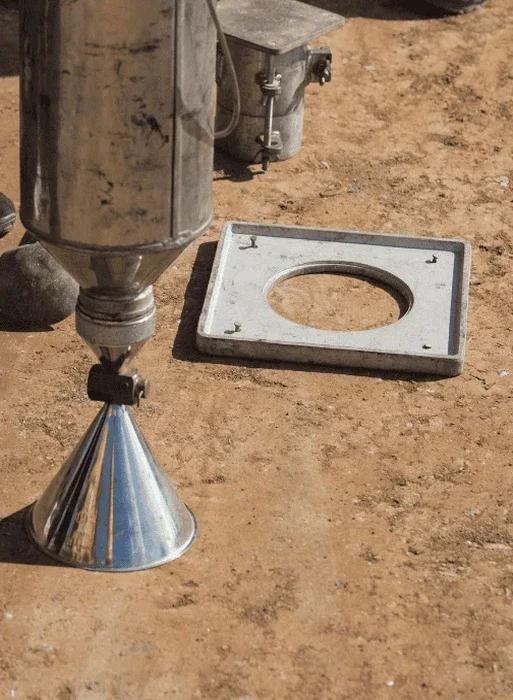
Critical ground factors in San Francisco
On San Francisco hillsides where Franciscan bedrock dips steeply beneath thin colluvial cover, we repeatedly see fill that passes density tests on the upper bench but fails at the slope interface because of moisture migration from the cut face. Ignoring that boundary zone leads to slope raveling and pavement distress within two wet seasons. Contractors who skip the sand cone test on utility trench backfill in the Marina District risk void formation during the next strong ground motion, a condition that amplified damage during the 1989 Loma Prieta earthquake. Another frequent problem is testing fill that has dried beyond the optimum moisture range, inflating density results and masking a collapse-prone soil structure. We address that by requiring a moisture check at each test station and rejecting results outside the spec envelope. The sand cone method also avoids the licensing and safety overhead of nuclear gauges, which matters on congested job sites near schools, hospitals, and transit hubs.
Our services
Our density testing program in San Francisco integrates compaction verification with the supporting laboratory and field services that engineers need to close out the earthwork specification.
Compaction Control Program
Sequential sand cone testing at designated grid points per lift, with immediate pass-fail feedback to the compaction crew and formal daily reports for the geotechnical engineer of record.
Proctor Curve Development
Standard and modified Proctor tests on site-sourced fill materials to establish the moisture-density target before field density testing begins.
Rapid Soil Classification
On-site sieve analysis and plasticity index determination to flag changes in fill material that would invalidate the reference Proctor curve.
Top questions
What does a sand cone field density test cost in San Francisco?
For a single test station within San Francisco, the sand cone density test typically ranges from US$90 to US$140 depending on access and the number of stations required per mobilization. Projects needing more than ten tests in one day benefit from a reduced per-station rate.
How deep can the sand cone method test?
The practical depth per test is one compacted lift, usually 6 to 12 inches. For deeper fill verification we excavate to the target lift and run the test on the exposed surface. The method is not intended for depths beyond a few feet in a single operation.
Is the sand cone method accepted by San Francisco DBI?
Yes, the San Francisco Department of Building Inspection accepts ASTM D1556 sand cone results for compaction verification of engineered fill, trench backfill, and subgrade preparation as part of the special inspection requirements under IBC Chapter 17.
What soil types are unsuitable for the sand cone test?
The method works poorly in clean, loose gravels with large voids, very soft cohesive soils that deform under the base plate, and saturated conditions where the hole walls collapse. In those cases we recommend alternative methods such as the drive cylinder or, when permitted, a nuclear density gauge with site-specific calibration.